Friday, April 17, 2015

April

Let's start with base technology today: we are slowly approaching the 10TB capacity point for 3.5" HDDs.
After Western Digital / HGST (which has been selling a helium-based 8Tb drive for a couple months already), Seagate has announced a 8TB drive as well: Not using helium to allow more platters inside the 3.5" form factor - but obviously basing their product on SMR (shingled magnetic recording) to achieve the required density.
This also explains the specific use case outlined in the announcement, described as "backup and objects": SMR disks use track overlay to reduce track width and thus have a limited capability to perform write updates to existing data / tracks. This is explained very well in this Wikipedia article here. Also refer to my previous blog-entry from November 2013!

There was other breaking news regarding storage capacity last week: The teams of IBM Research Zurich and Fujifilm have demonstrated an areal recording density of 123 billion bits of uncompressed data per square inch on low cost, particulate magnetic tape, a breakthrough which represents the equivalent of a 220 terabyte tape cartridge that could fit in the palm of your hand ! Read the details here.

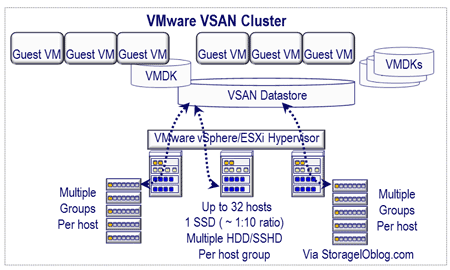
Moving up the solution stack, let's talk about " SAN" and it's younger sibling "VSAN": while SAN's have been around for some twenty years now, the current trend has been reversed and storage seems to move back into the server as a "virtualized" resource to be shared by multiple instances of the virtualized servers (VMware, Hyper-V, ....).
Here's a look back at SAN's and a thorough analysis of the capabilities (and limitations!) of VSAN!
VSAN is also one of the building blocks of VMware EVO:Rail and with the recent wave of EVO:Rail appliances hitting the market (among them the EMC VSPEX Blue) I found the article here to be a great summary and overview of this architecture/technology.
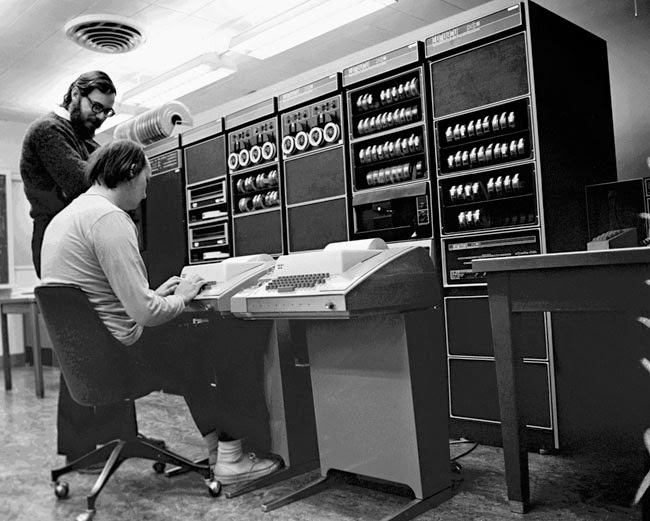
"Converged System circa 1977"

Which brings us to the "converged topic" and related material which is plentiful these days! Let's first look at the Q4 2014 market numbers as presented by IDC. The surprising #2 vendor for EMEA for the integrated infrastructure (with a triple-digit growth compared to Q4 2013!) is HP:
  • The EMEA "Integrated Infrastructure and Platform Revenue" report for all of 2014 can be found here.
  • The worldwide "Integrated Infrastructure and Platform Revenue" report for Q4 2014 can be found here.
As many of you certainly already figured out, "converged" is nothing new - it's rather the inversion of what started in the late 80ies and early 90ies as "client-server" architecture. Read this amusing story here!


Friday, March 27, 2015

March

Spring greets us with the latest IDC numbers about Q4 storage market details. I have compiled a couple of the reports below:

The one really stunning fact in the IDC worldwide external storage report (besides the not-so unexpected drop of 24% for IBM) is the 40% increase of revenue for ODM direct! You won't find ODM as a company - IDC adds up sales to all types of "managed service providers" under that category: overall, external storage shipments to ODM's account for 12.8% of the worldwide revenue in Q4! See details here.
And for EMEA: IDC EMEA external storage market report.


IDC worldwide PBBA (if you don't remember PBBA: purpose built backup appliance) report. Not much of a surprise there, EMC DataDomain has a very comfortable lead with over 60% share in that market - which is not really growing in terms of revenue as you can read in the report.
Where is this massive amount of storage going? Read here about the recent price offensive of Google for low-cost storage!

And don't forget to forward the clock on Sunday morning-if you live in Europe that is!

Tuesday, February 3, 2015

February

VSPEX Blue is the one hot topic today and is EMC's entry into the HCIA (hyper-converged infrastructure appliance) market! Based on VMware EVO:Rail and VSAN and preconfigured with RecoverPoint and EMC CloudArray software (among others).

Please read the official press release here and read Avnet's release here!

You may be slightly confused (as I still am) about the positioning of EVO:Rail VSAN and EMC ScaleIO from EMC which seem to address a very similar market and problem. I found  that article from "The Register" to be very helpful in understanding where which makes sense and what the similarities are.

Add Flash storage to the equation and read how PureStorage sees EVO.Rail and Flash and how they may or may not be combined in the future in AFHCIA's (all-flash hyper-converged infrastructure appliances).


Monday, January 5, 2015

January

Happy New Year!

I have summarized a couple of 2015 predictions, wish-lists and trends at the beginning of the year for you below. Of course they represent my personal beliefs about where the IT and Storage industry will be heading in the next 12 months - so feel free to disagree!

First let me revisit the state of the art in HDD capacity as of January 2015, here's a great writeup of what is available today: As you can see, we are rapidly approaching the 10 TB capacity limit - but data access performance remains an ever bigger problem with those huge disk drives. Related to that, RAID protection becomes less practical with every TB we add for single drives, so the industry is looking into new ways to protect data as you can read here!
And for the SSD segment of enterprise storage, read the 2015 wish list for AFA's (all-flash arrays).


Second, here's a number of analyst predictions for top 2015 storage trends and market developments:
Hot storage technologies for 2015 (most notably Cloud-based disaster recovery or DRaaS among them) and top storage start-ups (many of them supporting flavors of SSDs to maximize performance)  to watch this year!
And lastly from the NetApp CTO and industry veteran Jay Kidd, here's his personal view on 2015 trends.

Third: meet "Docker", the next big thing after hypervisors! Or as is explained in this paragraph on docker.com: "Docker is an open platform for developers and sysadmins to build, ship, and run distributed applications". It may be a smart thing to start to learn about Docker early in 2015 - so I have listed the link to a four part summary/basic overview from "The Register" here. Enjoy!


Friday, December 19, 2014

December

It has been a busy time for me and while I have continuously followed what's going on in the IT market, I did not have time to sit down and digest. So before 2014 is over, let's have a look at some recent news and how they fit into current trends:
If I had to summarize what I see going on right now is three major areas of excitement and start-up-activity:
  • Converged and Hyper-Converged Systems, goes hand in hand with the "software defined datacenter" topics and the Server-side SAN solutions.
  • Flash Storage and the question how a future "memory" or "storage" hierarchy will look like?
  • Cloud and all kinds of "managed services". Combined with the question which parts of IT will be on-premises - and what will be off-premises in a future scenario?
Along these lines, here's a writeup of recent news: The article here is a great analysis by industry veteran Jon Toigo about the new storage hype around server-SANs and the proclaimed death of the storage array as we know it. He states that "...there's no such thing as a true storage network, at least not one that fits the ISO model of networks. We have storage fabrics with switched DAS (SANs), and we have DAS with thin file server appliances (NAS). So, the idea that virtual servers won't work with anything but server-side direct attachment is silly."


It's impossible to understand server-SANs without knowing some details about VMware VVOLs (and here), VSANs (see also here), and most recently EVO:Rail Check the respective links for an explanation of each!
Please see my blogpost from Sept. 2013 as well, plus a great comparison of Hyper-Converged solutions here!

So while VSANs let's you control direct attached server storage from VMware, VVOLs provides a new construct (beyond NAS and LUNs) to manage external/SAN storage from VMware. And EVO.Rail (based on VSAN technology) is a complete software bundle from VMware which enables vendors (Dell, HP, and others have announced intents) to build their own "hyper-converged" appliances.

Reminds me of good old days of IBM mainframes where the "IO subsystem" was defined and under control of the base operating system. VMware obviously wants to gain control over the storage side of the datacenter and -in my opinion- they have a fair chance of winning that bet.

On to Flash: Combining the converged and flash hype will result in solutions like the one here: "Nutanix introduced a new all-flash storage appliance and a new feature that enables continuous availability across data centers."
And last week from Flash-leader PureStorage"Pure and Cisco have dreamed up FlashStack converged infrastructure (CI). This is a combination of combine Pure’s 400 Series arrays, Cisco UCS Blade Servers, Nexus switches, VMware vSphere 5 and Horizon 6".
However, this is mostly an unilateral attempt from Pure to hook up with CISCO - you will not find that specific solution on the CISCO CVD (CISCO validated design) site. No surprise; as they already have Invicta (to be integrated into UCS) and have created solutions with Nimble as well.

Closing todays comments with very recent news on AWS (Amazon web services):
"Amazon added storage features at its AWS re:Invent conference in November. They include support for larger and faster volumes on its Elastic Block Store (EBS). The enhancements center on solid-state drive (SSD)-backed EBS, which was launched back in June in all AWS regions. Amazon calls SSD EBS the fastest-adopted service in its Amazon Web Services portfolio."

What if - someday we may start over with a very disruptive and new way of computing? While dating back to Summer, the vision of "The Machine" sounds somewhat appealing to me!

Thursday, September 25, 2014

September

Networking news this month: Will 25 Gbps Ethernet be the next speed of choice? Read here why there's a couple good reasons to think so: "The next generation of Intel "Grantley" CPUs are due to ship in the third quarter, and servers with these processors will be able to forward data faster than 10 Gbit/s. In the high-density server farms of cloud providers like Google and Microsoft, using multiple 10 GbE would require twice as many Ethernet switches with their associated space, power, and cooling costs."

And on the Fibre Channel side of the market, CISCO quietly (and maybe reluctantly?) roles out a bunch of 16 Gbps products:
A new low-cost 16 Gbps switch (MDS9148S) and a smaller model of the MDS 9710 director (MDS 9106), a 192-port director in a 9U form factor!

Tuesday, August 12, 2014

August

Lazy summer days - mostly wet and rainy this year. So lots of time to read blogs and follow the IT News-tickers!

Here's what I found to be interesting news in the last couple weeks - sorted by "level of excitement".
First sighting of phase-change memory (PCM) for commercial use in SSD's: at the 2014 "Flash Summit Conference" HGST (subsidiary of Western Digital) did showcase a blazingly fast SSD device not based on Flash memory but PCM, as Computerworld reports here:
" The device, which can be plugged into a server's PCIe slot like any SSD, isn't a new storage product but a platform for demonstrating a low-latency interface that the company developed with future solid-state media in mind. It implemented the experimental communications protocol in a Linux driver on the server and in the SSD's embedded software."
"Where NAND Flash takes about 70 microseconds to respond to a request for data, PCM can do so in about 1 microsecond. However, it will take two to three years of hardware development before PCM gets dense and cheap enough to compete head-on with flash"

Also read the stories on that same subject in "The Register" and the related HGST Press Release.

As noted above, new low-latency technology like PCM will require new architectures and will have to reside "right next to the CPU" to actually take advantage of the available speed!
To that end, HGST has developed a new low-latency interface dubbed "DC express". 
Watch this excellent 15' video clip here!

So you should really think of PCM as a lower cost DRAM rather than a high performance Flash Array. Will be interesting how this will affect "storage tiers"!?

Now, don't count Flash SSD's out yet: As reported here, there is a whole family of bigger (up to 1.6TB) and faster (12 Gbit/s SAS) SSD's entering the market these days!